Pressure washer nozzle chart: what each color means, brand by brand
Last reviewed · 19 sources · Not tested by us: how we research
Go by the angle in your manual's nozzle table, not by the color. Simpson's manual lists red 0°, yellow 15°, green 25°, white 40° and black for soap 1, and Briggs & Stratton and Kärcher's HD 5/30 G use the same colors for the nozzles they list 2,3. But DeWalt, Craftsman and Poulan Pro make the 15° orange 4,5,6, Sun Joe makes the 40° gray 7, Ryobi names a blue or black soap nozzle 8, and Generac's electric manual gives its nozzles names and colors but no angle 9. No manual we read calls any color code a standard.
Paid links. As an Amazon Associate I earn from qualifying purchases, at no extra cost to you. It never changes what we recommend.
The short answer
Every quick-connect nozzle on a pressure washer (some call it a pressure cleaner or power washer) has an angle (0°, 15°, 25°, 40°), a soap setting or a turbo, and the color is the maker’s way to tell them apart. That’s the meaning of the colors, but each brand sets its own: Simpson’s manual uses red 0°, yellow 15°, green 25° and white 40°, and other makers share only part of it: the 15° is orange at DeWalt, Craftsman and Poulan Pro 4,5,6, the 40° is gray at Sun Joe 7. The chart below gives each manual’s own code; we haven’t tested any nozzle.
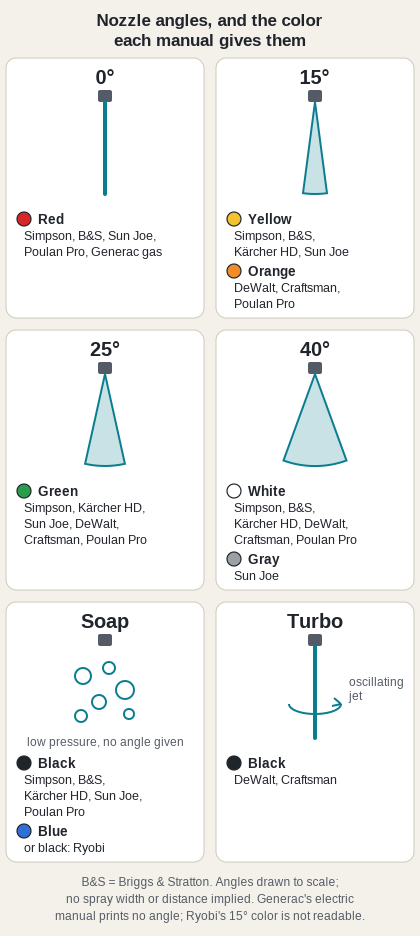
Nozzle chart by brand (from the manuals)
| Manual | 0° | 15° | 25° | 40° | Soap | Turbo |
|---|---|---|---|---|---|---|
| Simpson PS61251 / PS61254 1 | Red | Yellow | Green | White | Black | Not listed |
| Briggs & Stratton 020683 2 | Red | Yellow | No 25° in this manual | White | Black | Not listed |
| Kärcher HD 5/30 G (gas, pro) 3 | Not listed | Yellow | Green | White | Black | Not listed |
| Sun Joe SPX3000 7 | Red | Yellow | Green | Gray | Black | Not listed |
| DeWalt DWPW3000 4 | Not listed | Orange | Green | White | Not listed | Black |
| Craftsman CMEPW2100 5 | Not listed | Orange | Green | White | Color not given | Black |
| Poulan Pro PPW3400 6 | Red | Orange | Green | White | Black | Not listed |
| Ryobi RY141900 8 | Not listed | Not readable | Not listed | Not listed | Blue or black | Included |
| Generac electric g0088870 9 | No angle | No angle | No angle | No angle | Black | Not listed |
“Not listed” means the manual we read doesn’t put that nozzle in its table; your box may still contain one, or the maker may sell it apart. DeWalt even says the nozzles in its list might not be included with your washer 4. Generac’s electric manual names a red “Blast”, a yellow “Clean” and a green “Wash” nozzle, without angles 9. Champion’s 100787 parts list has a 0°, 15°, 25°, 40° and a detergent nozzle, without colors in the text we could read 11.
The usual color code, and the brands that break it
The full set (red 0°, yellow 15°, green 25°, white 40°, black soap) is Simpson’s table 1, and Briggs & Stratton uses the same colors for the four tips in its manual, which has no 25° 2. It’s a habit shared by several makers, not a standard: no manual we read calls it one.
The breaks:
- 15° in orange: DeWalt’s DWPW3000 and Craftsman’s CMEPW2100 list a 15° orange nozzle for brick or masonry 4,5; Poulan Pro’s PPW3400 lists red 0°, orange 15°, green 25°, white 40° and black soap 6.
- 40° in gray: Sun Joe’s SPX3000 lists its 40° quick-connect nozzle as gray 7.
- Blue for soap: Ryobi’s RY141900 manual says to install the “blue or black soap nozzle” 8. On that Ryobi, a blue nozzle is a soap nozzle.
- No angles at all: Generac’s electric manual names its nozzles Blast (red), Clean (yellow), Wash (green) and a black detergent nozzle 9, and Generac’s support article names them again by color, with different names (a yellow “Strip” nozzle) and no angle 13. Generac’s gas manual 006022 does list 0°, 15°, 25° and 40° nozzles plus a chemical injection nozzle 12, and calls the red (0°) the MAX nozzle 12; it doesn’t pair the other angles with colors in the text we read. If you own a Generac, go by your own manual’s names.
What each angle is for, in the makers’ words
| Nozzle | What the manuals say it’s for |
|---|---|
| 0° | Simpson: spot cleaning hard, unpainted surfaces; unpainted metal and concrete, “DO NOT use on wood” 1. Briggs & Stratton: maximum rinsing, paint removal, oil stains, rust 2. Sun Joe: tar and grease spots on concrete, caked mud on equipment 7 |
| 15° | Simpson: intense cleaning of unpainted surfaces (grills, driveways, unpainted brick) 1. DeWalt and Craftsman: brick or masonry 4,5. Sun Joe: intense cleaning on hard surfaces, only where the surface can take the pressure 7. Briggs & Stratton: general rinsing of siding, patios, decks, driveways 2 |
| 25° | Simpson: the standard nozzle for most jobs (yard tools, sidewalks, unpainted siding, gutters) 1. DeWalt and Craftsman: vinyl siding 4,5. Sun Joe: siding, patios, decks, driveways, after testing a small area 7 |
| 40° | Simpson: painted or delicate surfaces, including painted brick, painted stucco, vinyl and painted siding 1. DeWalt and Craftsman: automotive washing 4,5. Briggs & Stratton: cars, trucks, boats, RVs, patio furniture 2. Kärcher HD 5/30 G: the white 40° or green 25° for a gentle rinse 3 |
| Soap | Low-pressure detergent; Ryobi says no soap with its high-pressure nozzles 8 |
| Turbo | DeWalt and Craftsman: abrasive cleaning 4,5; DeWalt calls its turbo nozzle ideal for cleaning brick, concrete and vinyl 14 |
The 15° and 25° jobs overlap from one manual to the next: Briggs & Stratton gives decks and siding to the 15°, Sun Joe gives them to the 25°. Washing a car is a separate question, answered on our nozzle for a car page.
0° and turbo nozzles: the warnings
- Glass: Briggs & Stratton says not to point the spray gun at glass with the red 0° tip 2; Champion warns that a narrow stream or turbo nozzle may break a window 11.
- Surfaces: Generac’s electric manual warns, without naming the nozzle: “This nozzle can permanently damage work surfaces,” and says not to hold it too close or in one position for a long time 9; its gas manual says the red nozzle can damage the work surface 12. Sun Joe warns against permanently gouging wood with the wrong nozzle 7.
- Turbo: Westinghouse lists its 0° and turbo nozzles together, to clean concrete and strip paint, “Use with caution” 15; EGO says not to use its turbo nozzle on cars and wooden surfaces 16; Kärcher’s international K 5 manual says not to clean car tyres, paint or wood with the dirt blaster 17.
- Injection: Generac warns of a risk of fluid injection and says not to aim the spray gun at people, animals, electrical devices or fragile items 9. A wound from the spray can look minor and still be serious: get medical care 10. More on our safety page.
How far to hold the nozzle
| Source | Distance it gives | Scope |
|---|---|---|
| Generac gas manual 006022 | 8 to 24 in (20 to 61 cm) 12 | General cleaning |
| Briggs & Stratton 020831-00 | Not closer than 6 in (15 cm) with the high-pressure nozzle 18 | That machine’s 7-in-1 nozzle |
| Kärcher HD 5/30 G | About 1 ft from the surface; test a small area 3 | Gas pro washer |
| Kärcher K 5 Classic (international) | At least 30 cm on painted surfaces 17 | Painted surfaces |
| Champion 100787 | Start about 4 to 5 ft (1.2 to 1.5 m) away 11 | Starting distance |
These are each maker’s numbers for its own machine; we don’t add one of our own. The pressure to use on a car is covered by our PSI calculator.
Turbo and replacement nozzles
DeWalt describes its turbo nozzle as “a powerful oscillating jet of water” and sells two, matched to the washer’s pressure: the DXPA34TN with orifice size 3.0, for washers rated up to 3400 PSI 14, and the DXPA45TN with orifice size 4.0, up to 4500 PSI 19. DeWalt says the DXPA34TN connects to any standard quick-connect, cold water, gas pressure wand 14: check those three points in your own manual before buying. Before buying any loose nozzle, check the plug fits your wand: our quick connect page covers 1/4 in plugs and couplers.
Changing nozzles safely
The manuals don’t agree, and most of them say to stop the machine first:
| Manual | Before changing a nozzle |
|---|---|
| DeWalt DWPW3000 and Craftsman CMEPW2100 | “DO NOT attempt to change nozzles while pressure washer is running. Turn pressure washer unit OFF before changing nozzles.” 4,5 |
| Ryobi RY141900 | Never remove nozzles without first turning off the motor, disconnecting the power, relieving the water pressure in the trigger handle and locking the trigger 8 |
| Westinghouse WPX3200e | Stop the washer, turn the faucet off, release the pressure, lock the trigger 15 |
| Generac electric g0088870 | Do not adjust spray nozzles when the pump engine is running 9 |
| Briggs & Stratton 020683 | Tips can be changed while the washer is running once the spray gun trigger lock is engaged 2 |
| Generac gas 006022 | Never exchange nozzles without the trigger lock engaged 12 |
Five of these seven manuals ask you to stop the washer; the two that allow a running machine still require the trigger lock. Follow your own manual, and if it says nothing, the stricter rule costs only a few seconds. How the lock works on your gun is on our pressure washer gun page.
Which nozzle is best?
There is no best nozzle, only the one your manual names for the job: Simpson calls its green 25° the “Standard cleaning nozzle for most applications” 1, and DeWalt, Craftsman and Briggs & Stratton name the white 40° for cars 2,4,5 (details on our nozzle for a car page). For a garden hose nozzle rather than a pressure washer, see our garden hose foam gun page.
Where to go next
- Which nozzle for a car: what the manuals name for paint.
- Quick connect and fittings: what fits your wand.
- Pressure washer hose: sizes and pressure ratings.
Questions
What do the colors on pressure washer nozzles mean?
Each color marks one nozzle (a spray angle, or the soap or turbo nozzle), and the meaning depends on the brand. Simpson's manual lists red 0°, yellow 15°, green 25°, white 40° and black soap 1. DeWalt, Craftsman and Poulan Pro use orange for the 15° 4,5,6, and Sun Joe uses gray for the 40° 7. Check the nozzle table in your own manual.
Is the nozzle color code the same on every brand?
No. In the nine manuals of our chart, four make the 15° yellow (Simpson, Briggs & Stratton, Kärcher HD, Sun Joe) 1,2,3,7 and three make it orange (DeWalt, Craftsman, Poulan Pro) 4,5,6; Sun Joe's 40° is gray instead of white 7; Ryobi's manual names a blue or black soap nozzle 8; and Generac's electric manual names its nozzles by color without printing an angle 9.
What is the most powerful pressure washer nozzle?
None of the manuals we read uses the words "most powerful". Briggs & Stratton gives the red 0° tip to maximum rinsing 2, Generac's electric manual labels its red nozzle "MAXIMUM" 9, its gas manual calls the red (0°) the "MAX nozzle" 12, and Sun Joe calls its red 0° "an extremely powerful nozzle" 7. Turbo nozzles are a separate case: DeWalt and Craftsman list a black turbo nozzle for abrasive cleaning 4,5.
What are the Ryobi pressure washer nozzle colors?
We read the manual of the Ryobi RY141900, not those of Ryobi's other models. It comes with a 15°, a turbo and a soap nozzle 8, names a "blue or black soap nozzle" 8, and says not to use soap with the high-pressure nozzles 8. The layout of its nozzle chart was lost in the text we could read, so we don't give a color for its 15°.
What are the Craftsman pressure washer tip colors?
The Craftsman CMEPW2100 manual lists a 15° orange nozzle for brick or masonry, a 25° green for vinyl siding, a 40° white for automotive washing, a soap nozzle and a black turbo nozzle for abrasive cleaning 5. DeWalt's DWPW3000 gives the same colors and uses, but lists no soap nozzle in that table 4.
Is there a pressure washer nozzle chart PDF?
Your washer's own manual is the PDF to keep: each brand prints its own nozzle table, and the tables don't agree on colors. The manuals behind this chart are listed under Sources at the bottom of this page, with links.
Bottom line
Go by the angle in your manual, not the color: the colors are a habit, not a rule (yellow or orange for the 15°, white or gray for the 40°, blue or black for soap). Keep the 0° and turbo away from glass, wood and paint as the manuals say, and stop the washer before you swap nozzles, as five of the seven manuals we read on this point ask.
Next on your setup- Which nozzle for a car (coming soon)
- Pressure washer quick connect (coming soon)
- Pressure washer gun (coming soon)
- Pressure washer hose (coming soon)
What we checked, and what we didn't
- Pressure washer manuals: Simpson PS61251/PS61254, Briggs & Stratton 020683 and 020831-00, Kärcher HD 5/30 G and K 5 Classic (international edition), Sun Joe SPX3000, DeWalt DWPW3000, Craftsman CMEPW2100, Poulan Pro PPW3400, Ryobi RY141900, Champion 100787, Generac electric g0088870 and gas 006022, Westinghouse WPX3200e, EGO HPW2100.
- Generac support article on nozzle colors (read in a browser on 2026-11-17); DeWalt US pages for the DXPA34TN and DXPA45TN turbo nozzles; CDC pressure washer safety page (read on cdc.gov).
- The recommended or caution marks in the Champion 100787 and Ryobi nozzle charts, and the color of Ryobi's 15° nozzle: lost when the PDF was converted, not read.
- Manuals of Ryobi's 2300 PSI models and of Honda pressure washers: not read.
- Spray width at a given distance: no manual we read gives one, so the diagram shows angles only.
- We did not test any nozzle.
Sources
- Simpson PS61251 / PS61254 manual 7119629 (REV A 11/2022) · Simpson
- Briggs & Stratton pressure washer manual 020683 (copy hosted by a parts retailer) · Briggs & Stratton
- Kärcher HD 5/30 G gas pressure washer manual (BTA-5697689) · Kärcher
- DeWalt DWPW3000 instruction manual · DeWalt
- Craftsman CMEPW2100 manual (hosted by Lowe's) · Craftsman
- Poulan Pro PPW3400 gas pressure washer manual (hosted by Lowe's) · Poulan Pro
- Sun Joe SPX3000 operator's manual (trilingual copy hosted by RONA) · Sun Joe
- Ryobi RY141900 operator's manual (copy hosted by a parts distributor, APW) · Ryobi
- Generac electric power washer owner's manual g0088870 · Generac
- Pressure Washer Safety (natural disaster cleanup), read on cdc.gov in a browser · CDC
- Champion 100787 3500 PSI pressure washer operator's manual · Champion Power Equipment
- Generac gas power washer manual 006022 (copy hosted by a parts distributor, APW) · Generac
- Generac support article, What do the different colored nozzles do (read in Chrome on 2026-11-17) · Generac
- DeWalt US, DXPA34TN 3400 PSI turbo nozzle page · DeWalt
- Westinghouse WPX3200e manual (hosted by Lowe's) · Westinghouse
- EGO Power+ HPW2100 operator's manual · EGO
- Kärcher K 5 Classic operating manual (BTA-5958759, international edition with an EU declaration of conformity) · Kärcher
- Briggs & Stratton pressure washer manual 020831-00 (copy hosted by a parts distributor, APW) · Briggs & Stratton
- DeWalt US, DXPA45TN 4500 PSI turbo nozzle page · DeWalt
Revision history
| 2026-11-17 | First version. |